Available now in hard cover, paperback, audio, ebook

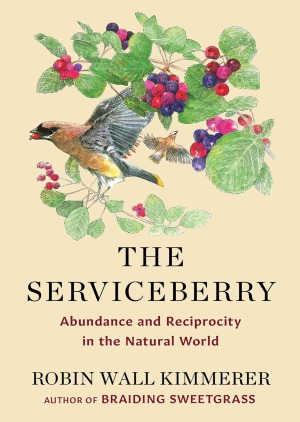
Why I loved THE SERVICEBERRY:
An unassuming plant, the serviceberry shares its bounty with wild creatures and people alike, asking only that it be honored as a kind gift.
From the perspective of being a mother, a scientist, a professor, and a member of the native Potawatomi Nation, rarely has there been one so qualified to muse on the notions of “scarcity” and “abundance.”
Those two concepts are opposites, aren’t they?
Not according to Kimmerer.
This is such an important concept in a world that sometimes feels empty. It is such a joyful affirmation that Yes! we can have it all … if only we want it all.
I’m on my third attempt at growing a serviceberry in my yard. The first two times failed. Maybe I’ve got it right this time.
Maybe our world can get it right too.
Cozy up … or fly away! Adventure … Romance … Inspiration … every week, straight to your IN box!
A Snippet
The guidance for the Honorable Harvest are not usually written down, they are reinforced in small acts of daily life. But if I were to list them, they would look something like this:
- Know the ways of the ones who take care of you, so that you can take care of them.
- Introduce yourself. Be accountable, as the one who comes asking for a life.
- Ask permission before taking. Abide by the answer.
- Never take the first one. Never take the last.
- Take only what you need.
- Take only that which is given.
- Never take more than half. Leave some for others.
- Harvest in a way that minimizes harm.
- Use it respectfully. Never waste what you have taken.
- Share.
- Give thanks for what you have been given.
- Give a gift in reciprocity for what you have taken.
- Sustain the ones who have sustained you and the Earth will last forever.
Talk a Little, Talk a Lot
All great reads, like this one, have themes or ideas, or just hints, for discussion topics in your book club. Here are a few ideas for you:
Other Topics and Titles You Might Enjoy
Africa Anthology Art Birds Book Banning Chronic illness Ecology Faraway Places Holocaust Japanese Internment Legends Magic Mexico Native Americans Peace Corps Poetry Siblings Somalia Writers/Poets

H IS FOR HAWK, by Helen Macdonald
Braiding Sweetgrass